Thanks for reading The Briefing, our nightly column where we break down the day’s news. If you like what you see, I encourage you to subscribe to our reporting here.
Greetings!
There may be some blurry light at the end of the tunnel for Marc Benioff. Salesforce’s fiscal third-quarter numbers released on Wednesday suggest its revenue from AI products is growing enough to lift its annual growth rate just a bit. Salesforce is still growing very slowly—its new projection is for revenue to expand 9.2% in the current fiscal year, when you exclude the impact of a recent acquisition. Still, for a company that has symbolized the challenges AI poses to enterprise software incumbents, any improvement in the trajectory counts as good news. Investors seemed satisfied: Salesforce stock rose 2% in after-hours trading.
Salesforce’s key AI product remains a relatively small revenue contributor. Salesforce reported that its Agentforce product did $540 million in annual recurring revenue in the quarter, representing an increase of 330% year on year. To put that into context, Salesforce expects total revenue in fiscal 2026 of about $42 billion. Moreover, Agentforce’s growth slowed slightly from the 400% growth rate in the second quarter, when ARR was $440 million, although such a red-hot growth rate would be expected to come down.
We should point out that ARR is a trendy metric startups like to use so they can give investors the rosiest picture possible of their business performance: It’s typically the result of multiplying a month’s revenue by 12. While the metric is useful for assessing a fast-growing business, actual quarterly revenue is more important. In Salesforce’s case, the annual recurring revenue figure implies Agentforce brought in $135 million in the quarter. That’s not a lot, given that Salesforce says it has now closed 9,500 Agentforce paid deals, including 3,500 in the third quarter. (Salesforce’s total revenue in the quarter, by the way, was $10.3 billion.)
Salesforce seems to be making more AI-related revenue from its Data 360 analytics service, as the company noted that annual recurring revenue for Agentforce and Data 360 together hit “nearly $1.4 billion.” The company described that figure as an “explosive 114% year-over-year gain,” which is a little over the top given that the growth rate is a slowdown from the 120% reported in the previous two quarters. Even so, the growing AI-related revenue likely explains why Salesforce has steadily lifted its fiscal 2026 revenue growth guidance to above 9% from its original projection of 6% to 7% issued in February.
Even after today’s after-hours rally, Salesforce stock is still down 27% on the year, making it one of the weaker performers among well-known tech names in 2025. As we’ve written extensively, AI is scrambling the enterprise software sector, pitting companies against each other in unprecedented ways. Salesforce, like Microsoft, has also faced difficulties persuading businesses to pay up for AI services known as agents, as we’ve written here and here. On Wednesday’s investor call, Benioff talked about how many businesses had tried to “DIY” their own AI service and found it very difficult, which he cast as good news for specialist AI software sellers like Salesforce. He also dismissed as a “false narrative” the idea that AI poses a threat to conventional software. Benioff, as always, is making big promises. He still has to deliver.
Apple’s Design Diaspora
Jony Ive isn’t the only former Apple designer to now be heading up design at another tech powerhouse. On Wednesday, Bloomberg reported that Meta Platforms had hired another top designer, Alan Dye, who reportedly ran the company’s user interface design team. Ive and his firm, LoveFrom, are leading hardware design for OpenAI.
Apple executives may not be crying too much about Dye’s departure. After all, as our Aaron Tilley reported, Apple’s most recent iPhone operating system design, dubbed Liquid Glass, which makes menus and other parts of the user interface appear translucent, was heavily criticized for poor legibility. Perhaps Apple is better off without him?
In Other News
• Database firm Snowflake said Wednesday its revenue rose 29% to $1.21 billion in the quarter that ended Oct. 31, beating its growth forecast for the quarter by 3 percentage points. CEO Sridhar Ramaswamy attributed the growth to increasing usage of Snowflake’s database products by companies running AI applications.
• Walmart has added new guidelines outlining how AI agents and large language models should interact with and access information from its website, making it the latest e-commerce company to clearly define how outside AI tools can use its site.
• Morgan Stanley has held preliminary talks with investors about offloading some of the credit risk associated with its data center loans, Bloomberg reported.
• OpenAI has agreed to buy Neptune, a startup that makes tools for monitoring and analyzing progress during AI model training.
Today on The Information’s TITV
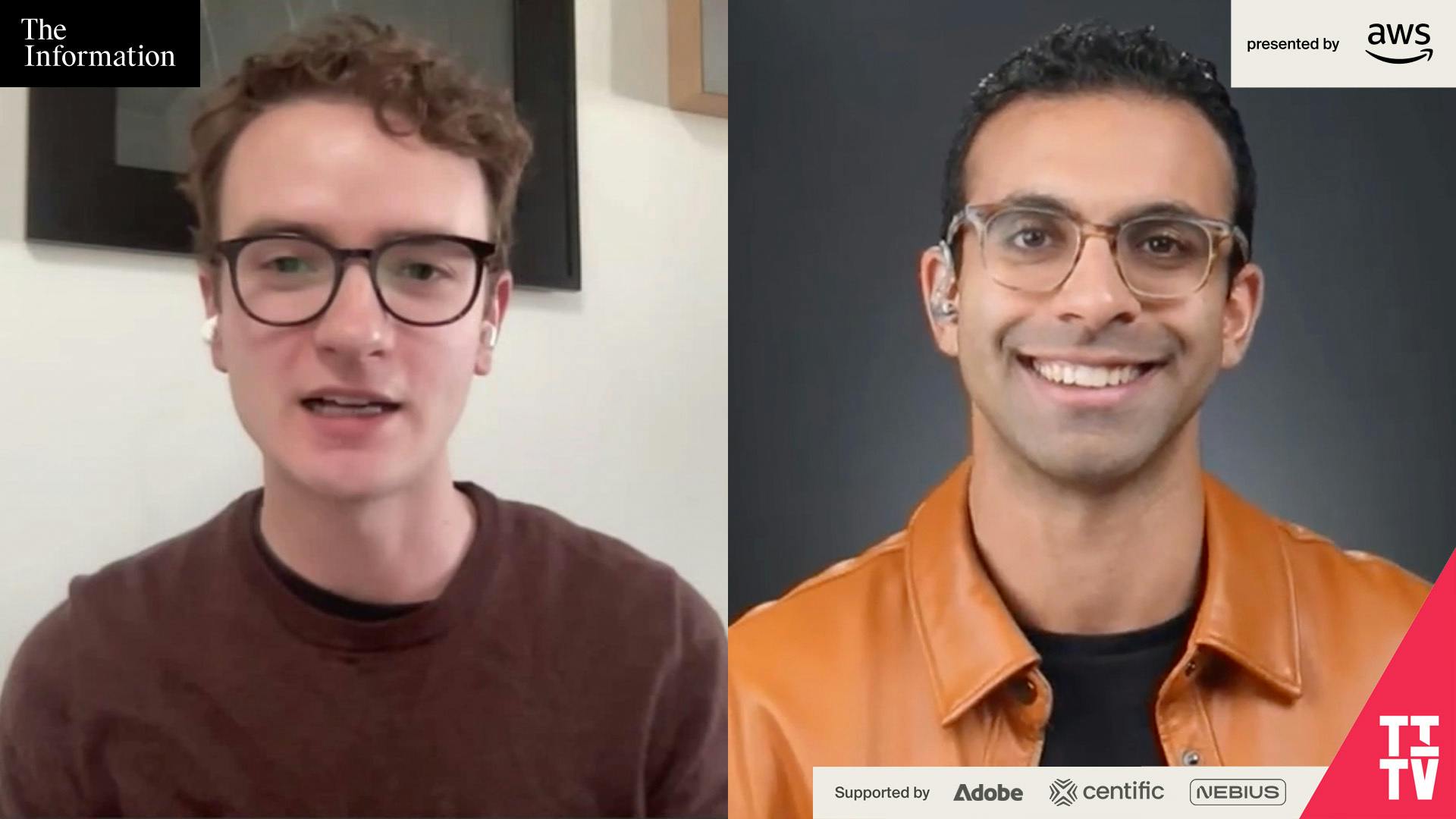
Check out our latest episode of TITV in which we talk with our Microsoft reporter about his market-moving story revealing the company’s lower sales targets for its cloud sales staff.
Recommended Newsletter
Start your day with Applied AI, the newsletter from The Information that uncovers how leading businesses are leveraging AI to automate tasks across the board. Subscribe now for free to get it delivered straight to your inbox twice a week.
Join The Information’s Kevin McLaughlin and executives from Atlassian and Eliza for an inside look at how companies are successfully driving AI adoption and seeing real results.